

Game development can be a good career for someone who enjoys both technology and creativity, is comfortable with a competitive job market, and is willing to keep learning.
Key takeaways:
- Game development is best suited to: Creative problem-solvers who enjoy teamwork, technology, and continuous learning.
- Main advantages: Interesting work, visible results, varied technical roles, and transferable coding skills.
- Main challenges: Strong competition, uneven job security, and deadline pressure.
- UK salary guide: The National Careers Service lists £27,000 for starters and £71,000 for experienced developers.
- Best early preparation: Finish small projects and build a strong portfolio.
- Good starting point for young learners: Game design, Python, Roblox, and guided project-based learning.
A game development career can be deeply satisfying. Your child can build interactive worlds, solve difficult technical problems, and see people enjoy something they helped create. Programming knowledge also translates to the wider tech industry.
For parents, the sensible goal is not to decide a child’s job title years in advance. A great first step is simply encouraging your child to create a game of their own. A hands-on project quickly shows whether they enjoy building and problem-solving, while also serving as an accessible launchpad into high-demand technical disciplines such as software development, systems architecture, and product design.
Help your child start building practical skills through fun, guided projects.
What Does a Game Developer Actually Do?
“Game developer” is a broad term. It can describe anybody who helps create a game, or it can refer specifically to a programmer.
Common game development jobs include:
- Game programmer: Builds systems, tools, and features by writing code.
- Game designer: Plans rules, levels, progression, and the overall player experience.
- Game artist: Creates characters, environments, effects and interfaces.
- Technical artist: Connects the art and engineering workflows.
- Producer: Handles schedules, communication, and project management.
- Engine programmer: Works on rendering, physics, performance, or engine development.
- Quality assurance tester: Finds and documents faults.
- Technical director: Leads major technical decisions and supports other developers.
The exact skills depend on the role.
A programmer needs strong logic and software engineering habits. A designer needs game design fundamentals, communication, and an understanding of player behaviour. Artists need visual skills and familiarity with relevant creative tools.
There are also different working environments. Game studios include indie studios, mid-sized studios, large publishers and freelance teams.
The encouraging news for parents is that learning game development does not lock a child into one job title. The programming knowledge, teamwork and creative thinking involved can also support a future in software development and the wider tech industry.
Why Can Game Development Be a Good Career?
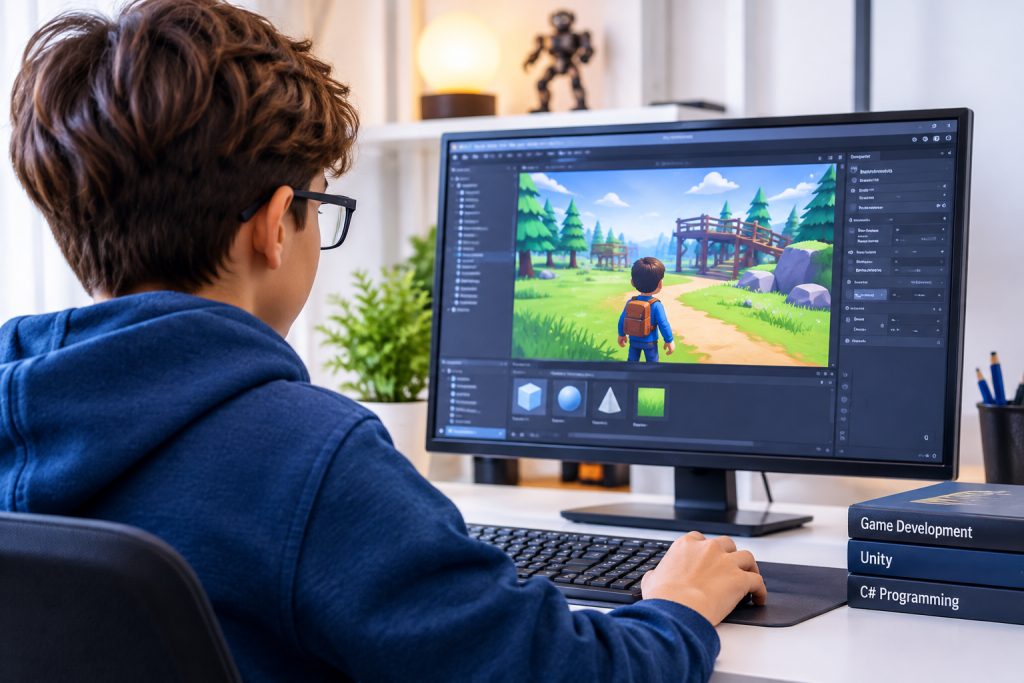
Game development blends technology, art, storytelling and logic. Here’s why game development can be a good career for your little ones:
It develops transferable skills
A child making games practises coding, data structures, planning and problem-solving. Those abilities are useful beyond the gaming industry.
A future game developer could later become a software developer, move into software engineering or work with mobile developers and other developers. This flexibility matters when parents are thinking about long-term earning potential and an uncertain economy.
It combines creativity with technology
Game development gives children space to test creative ideas. Indie studios and small teams may offer more creative freedom, while major studios and AAA studios provide specialist technical roles.
The work is varied too. Your child can soon build mobile games, live-service games, indie games, cloud gaming systems, virtual reality experiences, and augmented reality products.
Children can show what they have made
A completed game is visible proof of progress. Children can show their own games to family members, teachers and future employers. This makes a parent’s investment in structured coding lessons easier to see. Each finished project can become part of a strong portfolio while building confidence and continuous learning habits.
Turn your child’s screen time into valuable creator skills with Software Academy’s guided project-based learning.
What Are the Challenges of a Game Developer Career?
Game development is a good career choice, but it is not an easy one. Parents and students should understand the risks early.
Competition is strong
Many developers want to work in games. Entry-level game development jobs can attract applicants with degrees, game jams, placements and polished indie projects.
A bachelor’s degree or four-year degree may help with some technical roles, but formal education is not the only entry point. Most studios also want to see what a candidate can build.
Job security can be uneven
The latest UK evidence shows a difficult market. TIGA reported in March 2026 that direct UK games-development employment fell by 4.5%, from 28,516 people in May 2024 to 27,347 in September 2025.
During the same research period, 206 companies closed or left the industry. New-studio formation fell to 137, its lowest level in 15 years.
The picture was not entirely negative. Studios with 1 to 4 staff increased headcount by 3.2%, while those with 5 to 15 staff grew by 9.2%. Some indie studios and mid-sized studios are still creating job opportunities.
Crunch can affect work-life balance
Crunch culture means working prolonged hours near a deadline. It does not happen at every company, but it is a genuine concern.
The 2026 Ukie workforce survey found that 29% of respondents had worked more than 50 hours in at least one week during the previous year. It also found that 22% had experienced job loss during the previous three years.
A good career depends partly on the employer. Students should eventually ask game studios about overtime, project management and staff support, not just salary and exciting projects.
UK Game Developer Salary and Demand
The National Careers Service gives a game developer salary range of £27,000 for a starter to £71,000 for an experienced worker. It lists typical working hours of 30 to 45 hours a week, with occasional evening or weekend work.
Games can provide competitive salaries, especially for experienced developers with scarce technical knowledge. However, similar roles elsewhere in software development may pay more. Students should eventually ask whether a role offers enough money, healthy working conditions and useful experience.
Are game developers in high demand?
There is demand for specialist skills, but junior roles are competitive. The UK still has more than 27,000 people directly making games, yet the latest workforce count declined.
The wider job outlook for coding is stronger. The US Bureau of Labour Statistics projects 10% growth in employment for software developers and quality assurance analysts from 2025 to 2035.
Will AI Replace Game Developers?
AI tools will change game development, but they are unlikely to replace complete teams.
Many developers already use AI tools for research, prototypes, code suggestions and testing support. The 2026 GDC State of the Game Industry report found that 36% of respondents used generative AI at work. However, 52% believed it was having a negative effect on the industry.
AI cannot take full responsibility for gameplay programming, engine development, art direction, ethics or teamwork. Young people still need programming knowledge and the judgement to check results.
What Skills Does a Future Game Developer Need?
The exact skills depend on the career path. A game programmer needs different strengths from a game artist or technical director.
Useful foundations include:
- Writing code and debugging
- Game design fundamentals
- Logical thinking and data structures
- Gameplay programming
- Creative ideas and visual communication
- Teamwork with artists and other developers
- Project management and time planning
- Patience when solving problems
- Experience with tools such as Unreal Engine
Computer science and software engineering can provide valuable foundations. However, children do not need to master everything at once. A short, finished project is a much better beginning than an ambitious game that never gets completed.

Why a Strong Portfolio Matters
The National Careers Service advises candidates to create a portfolio or online demo for employers. This matters because a certificate alone does not show how someone approaches a real problem.
A beginner portfolio might contain:
- A simple Scratch game
- A small Python project
- A Minecraft coding project
- A Roblox experience built with Lua
- A mechanic made during a game jam
- Notes explaining the problem, code and solution
How Can a Child or Teenager Start Learning Game Development?
Children need an age-appropriate project and enough support to finish it.
A useful route is:
- Begin with visual logic and simple game design fundamentals.
- Move to Python or Lua when the learner is ready to write code.
- Use project-based lessons to build their own games.
- Add art, sound and asset creation after the core mechanic works.
- Keep each first project small enough to complete.
- Save finished projects in a growing portfolio.
Software Academy’s online game design courses for children aged 6 to 16 use practical projects in Unreal Engine. Learners explore 3D level design, game physics, interfaces, artificial intelligence and Blueprint scripting.
Children who are more interested in logic can take Python coding courses for kids. Learners who already enjoy Roblox can start with a Roblox course using Lua.
Term-Time classes provide steady progress alongside school. Private Tuition can suit a student who needs individual guidance or wants to move at a different pace.
Unlock your child’s inner developer with Software Academy’s online coding courses for kids.
For parents, the key test is simple. Does your child enjoy planning, making, testing and improving a game? If yes, structured projects can turn an interest in playing into a real technical and creative skill.
For a detailed overview of the career path, parents can also read about how to become a game developer.
FAQs
Is a career in game development worth it?
It can be worth it for a child who enjoys creative and technical work, but competition, crunch culture and job stability should be considered honestly.
Are game developers in high demand?
There is demand for skilled people, particularly in specialist technical roles. However, recent UK industry trends show that entry-level competition is strong and employment has declined. Broad coding skills provide more options inside and outside games.
Do game developers get paid well?
The National Careers Service lists £27,000 for starters and £71,000 for experienced developers. Actual pay depends on the role, location, specialism and studio.
Will AI replace game developers?
AI will automate parts of research, coding and testing, but it cannot replace the full range of technical, creative and team decisions involved in making games. Children should learn the foundations so they can use AI critically in the future.
How can a child or teenager start learning game development?
Start with one small project using Scratch, Python, Minecraft or Roblox/Lua. Software Academy’s online Term-Time classes and Private Tuition give children a structured way to learn, finish projects and build confidence.
Parents looking for more ways to support their child’s interest in coding and game development can also explore The Club to discover more from Software Academy.
A Positive First Step for Parents
Game development can be a good career, but children do not have to make that decision now. Coding projects let them explore the field while developing skills that remain valuable across software, technology and many other careers.
If your child already attends coding lessons, every completed project helps them build confidence and explore future options. If they are new to coding, a structured online class can provide a friendly entry point.
Your child can learn game design, coding, and problem-solving without committing to a single future job. Even if they later choose a different career path, those skills remain useful across the tech industry.
Help your child move from playing games to making games. Explore Software Academy’s online game design courses or coding and programming courses to find a suitable entry point.
